Choosing the right pin setup for your bow hunting sight is a trade-off between visibility and precision. While it’s tempting to grab whatever is on the shelf, your choice should be dictated by the specific environment you hunt in—whether that’s a dark timber hole in the Pacific Northwest or a sun-drenched canyon in the Southwest.
Here is a breakdown of how to choose the right pin configuration for your next hunt.
1. Choosing Your Pin Color: The Spectrum of Visibility
The human eye perceives colors differently based on the ambient light available. So if a color has worked for you in the past, there is nothing wrong with sticking to that color. But, here is how the big three colors stack up, keeping in mind that everyone sees things a little bit differently.

- Green: The undisputed champ for low light. Our eyes are naturally more sensitive to the green spectrum, making it look the “brightest” during those critical dawn and dusk moments. And in bright sunlight, green has more of a flat feel then the other colors. In other words it doesn’t blur or starburst as bad.
- Yellow: Offers high visibility and is a great secondary color for multi-pin sights, though it doesn’t quite match green’s performance in low light, and may blur a bit more in the middle of the day.
- Red: Red creates a sharp contrast against green leaves and or your other green pins, but it’s the first color to “disappear” as the sun goes down. In bright light, red fibers can also suffer from “starbursting” or blurring, making your aiming point feel larger than it actually is.
2. Pin Size: Precision vs. Performance
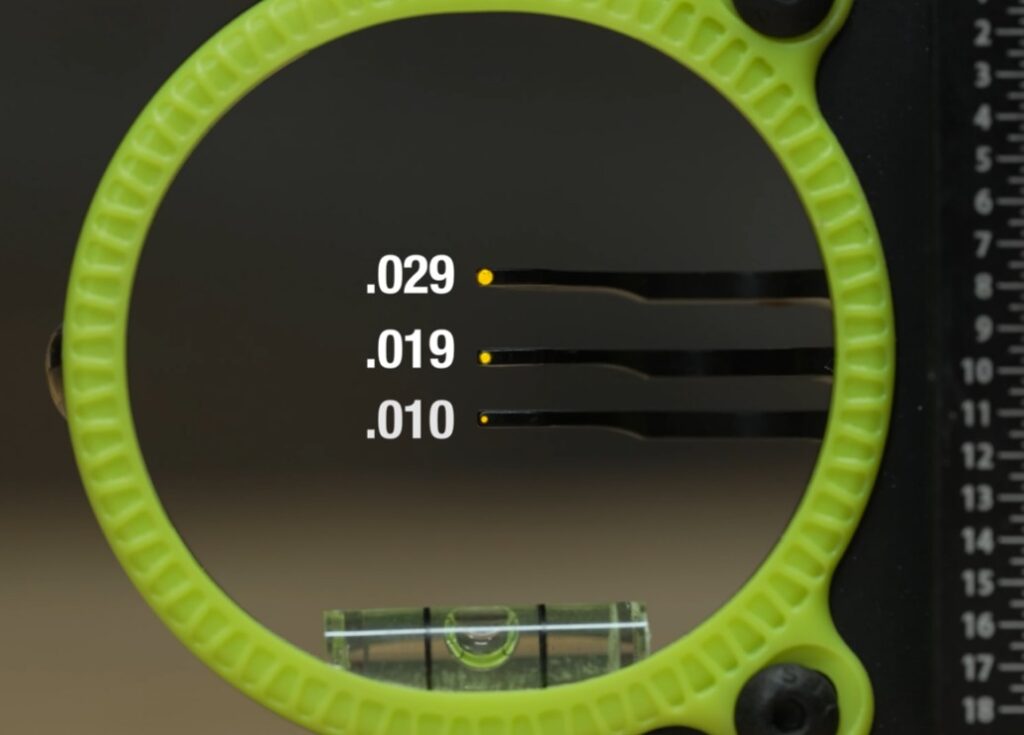
In the archery world, size matters. Most hunters find themselves choosing between .019 and .010 diameters. While .029 is also offered by some brands like Spot Hogg, we feel that its only useful for indoor target, or ground blind hunting where there is no ambient light. Its just very bright and tends to be too large to be useful for hunting.
| Pin Size | Best For… | The Trade-off |
| .019 | Low Light & Versatility | The standard for most hunters. It gathers more light, but in bright conditions, the “halo” effect can make the pin blur, potentially covering up your target at long range. |
| .010 | Long Range & Precision | Ideal for “threading the needle” at 40+ yards. However, they are significantly harder to see during the first and last 15 minutes of legal shooting light when the fiber has less UV to soak up. |
3. Who Makes the Best Pins?

Not all fiber optics are created equal. If pin brightness and durability are your top priorities, the industry generally follows this hierarchy:
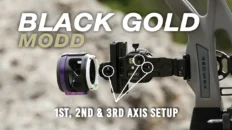
- Black Gold: Widely considered the gold standard. Their “PhotoChromatic” shell turns a dark purple that automatically darkens the pins in bright sunlight to prevent blurring while keeping them incredibly bright in the timber.
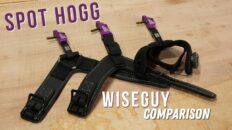
- Spot Hogg: Known for “Bulletproof” pins. Their fiber is protected extremely well, and their brightness is consistent and reliable for rugged backcountry hunts.
- HHA: A fan favorite for single-pin enthusiasts. HHA specializes in long strands of wrapped fiber that provide a very clean, bright aiming point, though sometimes the rheostat can be finicky.
Order and Symmetry
Choosing the right pins is only half the battle; how you order them determines how fast you can find your target under pressure. The goal is to build muscle memory so your eye automatically knows which pin is which without you having to “count” them.
Why Symmetry Matters
Symmetrical patterns require less cognitive load. When your adrenaline is spiking, you don’t want to be thinking, “Is the 40-yard pin the yellow one or the red one?” Using a consistent color for your primary distances—like all green for your “short” pins—builds a subconscious anchor. However, to prevent those pins from blurring together into one big glowing line, you can use size as a separator.
Pro Tip: The “Mixed Bag” Approach
If you use a multi-pin sight, many hunters prefer to mix their sizes. Try using .019 pins for your 20, 30, and 40-yard marks (for those closer shots you’ll take when light is usually lowest) and switching to .010 pins for your 50 and 60-yard marks where precision is more important than brightness and you’re less likely to use at first and last light.
The “Pro’s Choice” 5-Pin Setup
If you want a setup that covers everything from a 20-yard tree-stand shot to a 60-yard “no-dial” western shot, this configuration is hard to beat:

- 20 Yards: .019 Green (Maximum visibility)
- 30 Yards: .019 Green
- 40 Yards: .019 Yellow (The “anchor” or “bridge” color)
- 50 Yards: .010 Green (Transition to precision)
- 60 Yards: .010 Green (Maximum precision for long range)
Why this works: The yellow pin in the middle acts as a visual break. It tells your brain exactly where the “center” of your sight housing is. By switching to .010 pins at 50 yards, the pins become physically different enough that you won’t confuse your 40-yard “thick” pin with your 50-yard “thin” pin. You could also use a .010 yellow instead of .019. Just know that you won’t have the 40 yard option at first/last light. But the same logic applies.
The 4-Pin Strategy
For hunters who prefer a cleaner sight picture, a 4-pin setup is excellent because it’s an even number. You can split the housing into two distinct zones using size:

- Top 2 Pins: .019 (For low light/short range)
- Bottom 2 Pins: .010 (For stretching the distance)
This “split” allows you to instantly know if you are looking at your short-range or long-range “shelf” just by the thickness of the fiber optic.
The Ideal 3-Pin Setup
For many hunters, three pins is the “Goldilocks” zone—enough to cover your standard hunting distances without a cluttered sight picture. When building a 3-pin stack, you have two primary philosophies to choose from: Pure Consistency or Visual Separation.
Option A: The “High-Vis” Consistency Setup
Configuration: .019 Green | .019 Green | .010 Green
This is the “muscle memory” king. By keeping all the colors green, you ensure maximum brightness across the board.
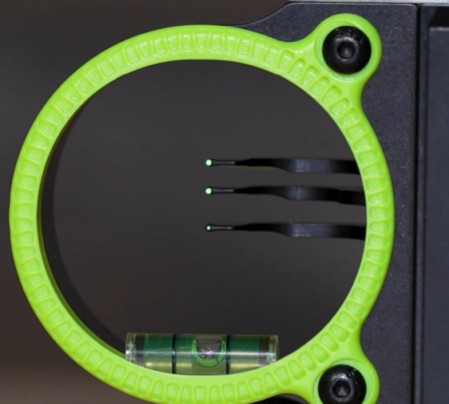
- The Logic: You use the larger .019 pins for your 20 and 30-yard marks where light might be low in the timber.
- The Break: You switch to a .010 Green for your 40-yard pin. Even though the color is the same, the physical size difference acts as a visual cue, letting you know you’ve reached your “long” pin without needing a different color to tell you so.
Option B: The “Anchor” Setup
Configuration: .019 Green | .019 Yellow | .010 Green
If you struggle with “pin confusion” (accidentally aiming with the wrong pin during a high-stress encounter), this is the setup for you.

- The Logic: The .019 Green at the top is your “quick-acquisition” pin for close-range shots.
- The Break: The middle .019 Yellow pin acts as a distinct “anchor” or “divider.”
- The Precision: The bottom .010 Green is your dedicated long-range pin. Because it’s separated by that yellow center, your eye instantly recognizes the bottom of the stack for those 40 or 50-yard shots.
Pin Stack Cheat Sheet
| Setup Style | Pin Configuration (Top to Bottom) | Best For… |
| The “Pro” 5-Pin | .019G, .019G, .019Y, .010G, .010G | Long-range precision without dialing; the yellow center acts as a visual anchor. Start at 40 and go up or down from there. |
| The “Split” 4-Pin | .019G, .019G | .010G, .010G | Clearly dividing your “short range” and “long range” zones by feel/size. |
| The “Anchor” 3-Pin | .019G, .019Y, .010G | Maximum sight window clarity with a distinct color break for the middle pin.Great for a 30-40-50 setup, or 20-30-40 |